A seal does not fail when rubber breaks. It fails when rubber stops pushing back. Compression set is the measurement of that second event, and it explains the most common service call in sealing: the O-ring came out intact, the gland looked clean, and the joint still leaked.
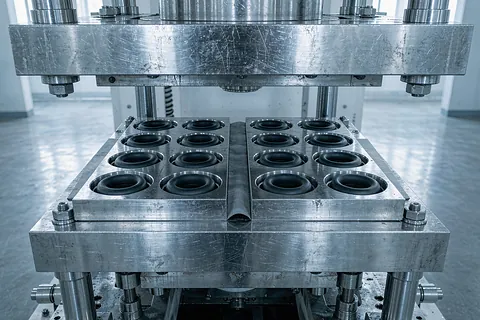
What compression set actually measures
Compression set is the permanent deformation left after a rubber specimen has been held under compression at temperature for a fixed time and then released. The test is defined in ASTM D395 Method B and, for finished O-rings, in ASTM D1414.
The arithmetic is simple. A specimen of original thickness t₀ is compressed to a spacer thickness t₂, held at temperature, released, rested, and measured at t₁. Compression set is:
CS = (t₀ − t₁) / (t₀ − t₂) × 100
A specimen compressed 25 % and returning to its full height scores 0 %. One that stays flat at the spacer height scores 100 %. Real compounds land between: a 70 Shore A nitrile held 70 h at 100 °C typically reports 20–30 %.
That number is not a material constant. It is the output of one specific test recipe, and changing the temperature, the time, the compression ratio or the recovery period changes the answer. Which is why a datasheet line reading "compression set 25 %" is meaningless until you read the conditions next to it.
is not how far the rubber was squashed, but how much of the resulting contact stress survives at the end of service. Set is the proxy for that loss, because a seal that has taken a set has less stored energy available to push against the groove.
Why set causes leaks even when nothing is damaged
An O-ring seals because it is squeezed. In a properly sized gland the cross-section is compressed 15–30 %, which generates contact stress against the groove floor and the mating surface. That stress has to stay above the media pressure for the seal to hold. Fluid pressure helps — it pushes the ring into the gap and adds to the contact load — but only if the rubber can still follow.
When the compound takes a set, the cross-section no longer returns to its original height. Contact stress falls, sometimes below the threshold needed at low pressure. The joint then behaves in a way that is easy to misread:
- It holds at high pressure, where the fluid itself loads the ring, and weeps at low pressure or on cool-down.
- It passes a bench test cold and fails after a thermal cycle.
- It seals in the factory and leaks in storage three months later, because the ring was compressed in a loosely assembled joint the whole time.
This is why "the O-ring looks fine" is not evidence. Set is dimensional, not visible: a ring that has lost 25 % of its squeeze looks like an O-ring.
The four variables that move the number
Temperature and time
Set follows Arrhenius behaviour. Every increment of temperature accelerates the crosslink rearrangement that makes deformation permanent, so a compound that reports 20 % at 70 h and 100 °C can report 40 % at the same duration and 125 °C. Time and temperature trade against each other, which is why comparing two compounds tested at different temperatures tells you nothing.
For specification work, ASTM D2000 suffix codes encode both the test temperature band and the maximum permitted set, so a callout carries its own conditions. When a drawing just says "compression set ≤ 25 %", ask at what temperature and for how long before quoting.
Compression ratio
Squeeze drives set. At 15 % compression, most elastomers recover well. Push to 30 % and the numbers climb, because a larger fraction of the polymer network is held in a deformed state for the whole test. Above roughly 40 %, set rises steeply and the ring may also take a mechanical set from extrusion into the gland corners.
The practical consequence is that you cannot fix a marginal seal by over-squeezing it. Going from 20 % to 30 % squeeze to stop a leak buys contact stress now and pays for it with a shorter sealing life.
Media
Air is a benign environment compared with oil. A nitrile ring tested in air and the same ring tested in IRM 903 oil will not report the same set: swelling softens the compound, and a softened network deforms further under the same load. In aggressive media the correct measure is set after immersion, not set in air.
Compound and cure
Higher crosslink density resists set. That is the whole trade: more crosslinks mean better set resistance, worse low-temperature flexibility and, past a point, worse compression set under dynamic load because the network is brittle. Peroxide-cured EPDM outperforms sulphur-cured EPDM on set at temperature for exactly this reason, and it is why two compounds with the same hardness and the same base polymer can differ by 10 points of set.
Typical limits, and what they are worth
The table below is the range seen across published datasheets for standard 70 Shore A compounds, tested 70 h at the listed temperature with 25 % deflection. These are typical values, not requirements — the requirement is whatever your drawing says.
| Compound | Test temperature | Typical set | Comment |
|---|---|---|---|
| NBR | 100 °C | 20–30 % | Rises sharply above 100 °C; not a high-heat choice |
| HNBR | 150 °C | 20–30 % | The reason HNBR exists: same oil resistance, more heat |
| FKM | 200 °C | 20–30 % | Lowest set of the common compounds at temperature |
| EPDM | 125 °C | 20–30 % | Peroxide cure better than sulphur cure |
| VMQ (silicone) | 175 °C | 20–35 % | Excellent at temperature, poor recovery at room temperature |
| FFKM | 200 °C | 15–25 % | Justifies its price only where nothing else survives |
Silicone deserves a note because it is routinely misunderstood. Silicone keeps its set numbers at high temperature but recovers slowly at room temperature, so a silicone ring compressed in a cold gland for weeks may not return quickly when the joint opens. For a static seal held at temperature this rarely matters. For an access cover opened monthly in an unheated plant, it does.
Reading set from a failed part
When you cut a leaking joint open, the ring's cross-section is the evidence. Measure the radial width of the cross-section in the compressed direction and compare it with the nominal value from the size table. For an AS568-214 the nominal cross-section is 0.139 in (3.53 mm); if the recovered section measures 0.125 in after an hour at room temperature, the compound has taken a set of roughly a quarter of its squeeze.
Then separate set from its neighbours, because the remedies differ:
- Hard and flat — heat ageing. The compound has lost elongation as well as height. Cure system and temperature rating are the problem.
- Soft, swollen, flat — media attack. Check swell against the actual fluid, not the fluid class.
- Flat but still elastic — mechanical set from over-compression or a gland that is too shallow.
- Chewed on one side — not set at all. Extrusion or installation damage; see the failure analysis note.
Designing so that set does not matter
Set cannot be eliminated, only budgeted. Four decisions do most of the work:
- Keep squeeze in the 15–25 % band for static radial seals. Enough stored energy, not so much that the network is held deep in deformation for years.
- Size the gland for the compound, not just the O-ring. A compound with a high set number needs more initial squeeze to end up at the same retained stress.
- Limit continuous temperature to the compound's rated range, not its peak. Peak ratings are excursion limits measured in hours.
- Use a harder compound or a back-up ring instead of more squeeze when the failure mode is extrusion. Adding squeeze to fight extrusion makes set worse and does not close the clearance.
names the test, the temperature, the duration, the deflection and the acceptance limit together — for example "compression set per ASTM D395 Method B, 70 h at 100 °C, 25 % deflection, maximum 25 %", carried as an ASTM D2000 suffix rather than as a free-text number.
Where compression set is the wrong explanation
Set is blamed for a lot of failures it did not cause. It is not the answer when the ring is cut or nibbled (installation or extrusion), when the leak appears only at high pressure (clearance and support), when the leak follows a temperature drop below the compound's glass transition (low-temperature stiffening, a different mechanism), or when the ring is swollen and soft (media incompatibility).
The distinguishing question is simple: did the cross-section come back? If it did, and the joint still leaked, look at clearance, surface finish or installation — the seal was never the problem.
Frequently asked questions
Does compression set increase with hardness?
Usually it falls. A 90 Shore A compound has more crosslink density and more filler, both of which resist permanent deformation, so its set number is typically lower than the 70 Shore A version of the same polymer. The trade is low-temperature flexibility and the ability to conform to a rough surface.
Can an O-ring recover from compression set?
Partially, and slowly. Elastomers are viscoelastic: after release, part of the deformation recovers in minutes and part over days, asymptotically approaching a residual value. The standard recovery period for measurement is short by design; in service, a ring that has been compressed for a year will not return to nominal no matter how long you wait.
Is a lower compression set number always better?
Not automatically. Chasing the lowest set number pushes you toward high crosslink density, which costs low-temperature performance and elasticity. For a static seal at moderate temperature a 30 % set compound that stays flexible at −40 °C may outlast a 20 % set compound that goes glassy in winter.
How long should a compression set test run to predict service life?
The standard 70 h test ranks compounds; it does not predict years. For life prediction, run the test at three temperatures and at least two durations, then fit the Arrhenius relationship between set and time. That is an engineering exercise with a real cost, and it is worth it only for a seal that is expensive to replace.
Does the groove depth tolerance affect measured set?
Yes, indirectly. Set is measured on a specimen compressed to a fixed spacer thickness, so the test itself is not affected by your gland. But a gland at the shallow end of its tolerance compresses the ring more than nominal, and the ring then behaves like a specimen tested at higher deflection — with a higher set number than the datasheet.