Three ways to find the part
Most enquiries arrive as a number from a drawing or a worn part in a bag. Pick whichever you have.
By dimension
Search the AS568 table in inch or millimetre, or pick a cross-section and walk the sizes that fit the same groove.
By drawing number
Paste the MS or M number from your drawing. Each page shows whether it is still orderable, and what to order if the document was replaced.
By compound
Fifteen compounds from NBR to FFKM, each with its service band and the media it will and will not survive.
Sizes that come up every week
Both unit systems on one line, because the drawing in front of you may use either. The last two columns count military designations on record for that dash number, and how many of them you can still order as printed.
| Dash no. | ID (in) | CS (in) | OD (in) | ID (mm) | CS (mm) | Mil refs | Orderable |
|---|---|---|---|---|---|---|---|
| -010 | 0.239in | 0.070in | 0.379in | 6.07mm | 1.78mm | 13 | 7 |
| -110 | 0.362in | 0.103in | 0.568in | 9.19mm | 2.62mm | 13 | 7 |
| -210 | 0.734in | 0.139in | 1.012in | 18.64mm | 3.53mm | 13 | 7 |
| -214 | 0.984in | 0.139in | 1.262in | 24.99mm | 3.53mm | 13 | 7 |
| -222 | 1.484in | 0.139in | 1.762in | 37.69mm | 3.53mm | 13 | 7 |
| -325 | 1.475in | 0.210in | 1.895in | 37.47mm | 5.33mm | 13 | 7 |
| -425 | 4.475in | 0.275in | 5.025in | 113.66mm | 6.99mm | 13 | 7 |
Six series, one numbering system
The first digit of a dash number tells you the cross-section, not the diameter. That is why a -214 and a -114 are the same nominal 1 in bore but will not interchange.
Fifteen compounds, one size table
The same AS568-214 exists in every compound below. The size never changes; the compound decides whether the seal survives the service.
What we control in-house
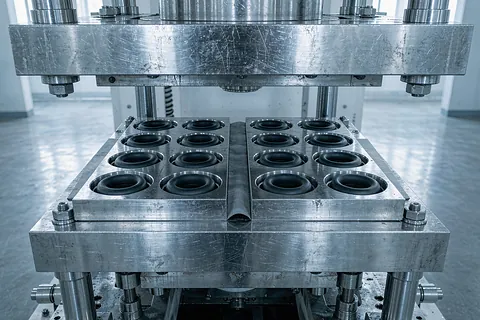
Compression and transfer moulding
Presses from 25 to 300 t, cavities up to 96 per tool. Flash-free edges on sizes below 100 mm ID.
In-house compound mixing
Fifteen standard compounds plus customer-specific formulations. Batch records kept seven years.
Batch-level testing
Hardness, tensile, elongation, compression set and specific gravity on every production lot.
Traceability to the drawing
Each shipment carries the compound batch, cure date and the standard revision the part was made to.
From drawing to delivery
Send the number
A dash number, an MS number, or a drawing. A photo of the old part works too.
We confirm the spec
We reply with the current revision, the compound we recommend, and any superseded reference on your drawing.
Sample in 5 days
Standard compounds ship as samples within five working days; custom formulations take ten.
Production & traceability
Lot testing, batch records and the revision stamped on the packing list.
Engineering notes
What fails, why it fails, and how the numbers in the size table turn into a gland.
O-Ring Compression Set: Why a Seal That Looks Fine Still Leaks
Compression set is the most common reason a used O-ring stops sealing. How it is measured, which limits actually apply, and how gland design and compound choice move it.
O-Ring Groove Design: Depth, Width and Squeeze for AS568 Sizes
How to turn an AS568 cross-section into a working gland: squeeze targets by seal type, groove width from fill ratio, clearance limits and the tolerance stack that decides whether it seals.
O-Ring Failure Analysis: Reading the Evidence on a Failed Seal
Nine failure modes, what each one looks like on the removed part, the root cause behind it, and the design change that actually fixes it. A working checklist for maintenance and QA.
How to Measure an O-Ring: ID, Cross-Section and Two Mistakes That Ruin an Order
Most wrong orders are not supplier errors; they are measurements of the outside diameter reported as the inside. How to measure a used or unknown ring, and when a caliper is the wrong tool.