A failed O-ring is a record of what happened to it. The shape of the damage, where it sits on the circumference, and whether the surface is torn, swollen, hardened or chewed all point at a different mechanism — and each mechanism has a different fix. Replacing the ring without reading it usually means replacing it again.
The method below is the one used for warranty and field-return analysis: look first, measure second, conclude last. The single most useful habit is to photograph the ring in place, before removal, and then on a clean sheet with a scale in frame.
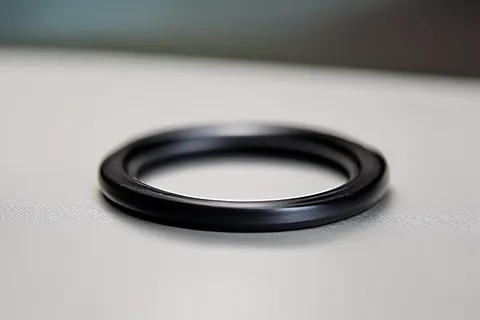
The nine modes at a glance
| What you see | Mode | Usual root cause |
|---|---|---|
| Flat cross-section, no tear, still elastic | Compression set | Over-squeeze, temperature above rating, time |
| Flat, hard, cracked in fine lines | Thermal ageing | Continuous temperature above compound rating |
| Swollen, soft, sticky, strong odour | Chemical attack | Wrong compound for the media |
| Nibbled or chewed on the low-pressure side | Extrusion | Clearance too wide for pressure and hardness |
| Clean cut across the section | Installation damage | Sharp edge, missing chamfer, burr |
| Spiral tears, ring twisted into a helix | Spiral failure | Assembly roll, uneven squeeze, poor lubrication |
| Flattened band, glazed, worn on one face | Abrasion | Dynamic service, rough surface, contamination |
| Blisters, voids, spongy areas | Rapid gas decompression | High-pressure gas, fast depressurisation |
| Ring intact, joint leaks, no visible damage | Wrong size or wrong groove | Design error, not a seal failure |
Start by measuring the cross-section
Before interpreting anything, measure the recovered cross-section with a caliper that has flat anvils, and compare it with the nominal value for the dash number. An AS568-214 is 0.139 in; a measurement of 0.125 in after an hour at room temperature means the ring has lost about a quarter of its squeeze permanently, and set is the primary story. A measurement at or near nominal means the seal never lost its stored energy, so the leak is coming from somewhere else.
Measure in two directions. A ring that is flat in one direction and full in the other has been squeezed unevenly — a gland problem or an assembly problem, not a material problem.
Mode 1 — Compression set
The cross-section does not come back. Edges may look slightly square. The ring is usually still elastic to the touch, just shorter in the compressed direction.
Set is a budget, not a defect. Every elastomer takes some. The failure threshold is when the retained contact stress falls below what the joint needs, which happens earlier at low pressure than at high. This is why a set-failed joint often holds at pressure and weeps when the line is cold.
Fix: reduce squeeze to the 15–25 % band, verify the continuous temperature against the compound rating rather than its peak, and check whether the media is swelling the ring and softening it. The detailed treatment is in the compression set note.
Mode 2 — Thermal ageing
Now the rubber is hard and has lost elongation. Bend it and fine cracks appear on the surface; in advanced cases the cracks go through the section. The ring may be discoloured and smell burnt.
This is not set. Set is deformation; ageing is chemical change. A ring can be aged without being flat if the gland had light squeeze.
Fix: the compound is running above its continuous rating. Nitrile at 100 °C is at its limit; a joint that sees 120 °C needs HNBR or FKM. Note that heat ages rubber faster in air than in oil, so the same compound may survive in a submerged application and fail in the same temperature in air.
Mode 3 — Chemical attack
The ring is swollen, soft, sometimes sticky or crumbly, and may smell of the fluid. Volume swell above about 15 % in a static gland is enough to cause problems; in a groove sized for zero swell it can hydraulically lock the joint.
The error is usually selection by fluid class rather than by the actual fluid. "Mineral oil" covers a wide family, and additives matter: the same nitrile that survives one hydraulic oil for years may swell badly in another because of its ester content or its additive package.
Fix: test in the actual fluid at the actual temperature. Where a test is impractical, use a compound with broader resistance (FKM for fuels and oils) and accept the low-temperature cost.
Mode 4 — Extrusion
Chewed, nibbled or feathered material on one side, always on the low-pressure side of the ring, often with a matching witness mark on the groove edge. In severe cases a piece of the ring has been cut away.
Extrusion happens when the clearance is too wide for the pressure and the material too soft. It is progressive: a small nibble creates a leak path, the leak increases pressure on the damaged area, and the damage grows.
Fix: reduce clearance, increase hardness, or add a back-up ring. Do not add squeeze — it increases the force driving rubber into the gap and accelerates the failure.
Mode 5 — Installation damage
A clean, sharp cut across the section, or a series of cuts around one part of the circumference, with no wear anywhere else. The cut faces often match up exactly when the ring is reassembled.
This is the most common cause of a seal failing in the first hours of service, and it is always an assembly problem. Sharp groove edges, missing chamfers, burrs on cross-drilled ports, threads crossing the sealing path, and a ring dragged over a keyway all produce it.
Fix: chamfer and radius the entry, deburr the ports, cover threads and splines with a sleeve during assembly, and use assembly lubricant compatible with the system fluid.
Mode 6 — Spiral failure
The ring is twisted into a helix, with diagonal tears that may look like a series of cuts at an angle. It happens in dynamic service where the ring rolls in its groove instead of sliding.
Causes are a combination: too much squeeze for the stroke, uneven squeeze around the circumference (eccentric bore or out-of-round groove), dry assembly, or a stroke speed that makes the ring roll.
Fix: reduce squeeze, improve bore roundness, lubricate at assembly, and check that the groove width lets the ring slide rather than roll.
Mode 7 — Abrasion and wear
A flattened, glazed band on the sealing face, sometimes with a step where material has been worn away. Common in rod seals handling dirty fluid.
The surface finish, the fluid cleanliness and the stroke length all contribute. A seal running on a 32 µin surface with particulate contamination will wear visibly in weeks.
Fix: improve bore finish to 8–16 µin Ra, add a wiper or scraper ahead of the seal, and filter the fluid.
Mode 8 — Rapid gas decompression
Blisters, voids or a spongy texture through the section. The ring may look intact from outside and crumble when cut. It occurs in high-pressure gas service when the gas dissolved in the rubber expands faster than it can diffuse out during depressurisation.
Fix: use a compound rated for RGD service (usually a harder, highly crosslinked grade, sometimes with reduced gas permeability), limit depressurisation rate, and avoid sharp pressure drops across the seal.
Mode 9 — Nothing wrong with the ring
The ring measures nominal, shows no damage, and the joint still leaks. Now the seal is innocent and the design is guilty. The usual causes are a groove too deep, a groove too wide, the wrong dash number, an out-of-round bore, or a surface finish the rubber cannot conform to at low pressure.
Fix: measure the gland, not the ring. Check depth, width, roundness and finish. The compression set note and the groove design note cover the arithmetic.
Building the evidence for a claim
A failure report that gets a supplier's attention has four things: the service conditions (media, pressure, temperature, duty cycle), the installation record (lubricant, torque, assembly method), photographs of the ring in place and on a scale, and dimensional measurements of both the ring and the gland. Without the gland measurements, every conclusion is a guess about the rubber, and the rubber is usually the last thing that went wrong.
did the ring lose its stored energy, or was it damaged? Loss of energy points at set, ageing or swelling — material and temperature. Damage points at extrusion, installation or abrasion — geometry and assembly. Measure the cross-section first and you have your answer in a minute.
Frequently asked questions
Can I tell a compression set failure from a thermal ageing failure without a lab?
Usually yes. Set leaves the ring flat but elastic; ageing leaves it hard and prone to surface cracks when bent. If you can bend the ring double without cracking, set is the more likely story.
Why did the O-ring fail only on one side?
Uneven squeeze, uneven clearance or localised heat. Check bore roundness and groove concentricity first, then look for a witness mark that shows where the ring was pinched.
The ring is swollen but the fluid is on the compatibility chart as acceptable. Why?
The chart gives a class, not your fluid. Additives, temperature and concentration all change the result. Swell is strongly temperature-dependent, so a compound listed as acceptable at 20 °C may swell far more at 80 °C.
How long should a seal last?
There is no generic number. A static nitrile seal in clean oil at 60 °C can last a decade; the same compound in a dynamic application at 90 °C with contaminated fluid may last months. Life is set by the temperature and the duty cycle, not by the material alone.
Should I replace the O-ring every time I open a joint?
For critical joints, yes — the cost of the ring is trivial against the cost of a leak. For low-pressure water joints, a ring that measures nominal and shows no damage can be reused once, provided it is cleaned and relubricated. Never reuse a ring that has taken a set.