Seventy Shore A is the default because it is the compromise that fails least often: soft enough to conform to a machined surface, hard enough not to extrude through a normal clearance, and available in every compound from every supplier. Most seals should be 70A. The interesting engineering starts when you have a reason to leave it.
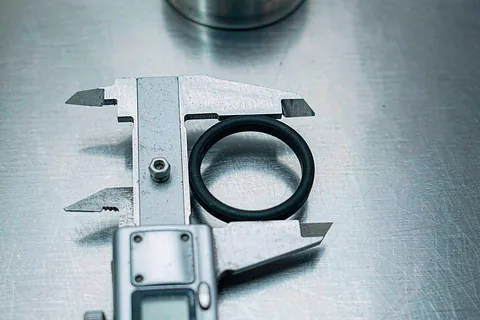
What hardness actually changes
Shore A measures resistance to indentation, not stiffness in tension and not chemical resistance. Four things follow from it:
- Extrusion resistance rises with hardness. A 90A ring bridges a wider clearance at the same pressure than a 70A ring.
- Seating force rises with hardness. A harder ring needs more squeeze to reach the same contact stress, and pushes back harder on the joint.
- Conformability falls with hardness. A 90A ring will not fill a 32 µin surface as readily as a 70A ring at low pressure.
- Friction rises with hardness in dynamic service, though the surface and lubricant matter more than the durometer.
Choose hardness to fix a mechanical problem — extrusion, deformation, friction — not to fix a chemical one. A 90A nitrile is not more oil-resistant than a 70A nitrile; it is the same polymer with more filler and crosslink density, and it will swell by the same percentage.
The three grades that cover most work
| Hardness | Use it when | Watch out for |
|---|---|---|
| 50 Shore A | Low pressure, rough or cast surfaces, large covers, vacuum where conformability matters | Extrudes easily above about 1,000 psi; takes set more readily |
| 70 Shore A | Default for static and most dynamic seals up to about 1,500 psi | Nothing systematic — it is the reference point |
| 90 Shore A | High pressure, wide clearance, high-temperature joints where set must stay low | Poor low-temperature flexibility; higher seating load; harder to install |
A 80 Shore A grade exists and is used in some hydraulic work, but it is not a standard shelf item everywhere; specifying it narrows your supplier list for a marginal gain over 90A.
Hardness versus clearance: the table that decides it
The pressure–clearance ceiling scales with hardness. Published gland design guides give roughly:
| System pressure | 70 Shore A | 90 Shore A |
|---|---|---|
| 1,000 psi | 0.012 in | 0.016 in |
| 1,500 psi | 0.008 in | 0.012 in |
| 2,500 psi | 0.004 in | 0.006 in |
Read this as "with this hardness, the joint may not open wider than this at this pressure". If your tolerance stack gives 0.010 in clearance at 2,000 psi, a 70A ring will extrude and a 90A ring is marginal — the correct answer is a back-up ring, not a harder compound.
The low-temperature trap
Hardness is measured at 23 °C. At −40 °C the same 70A compound behaves like a much harder material — typically the stiffness of a 90A ring at room temperature, and in some compounds worse. A seal that is correctly sized at 20 °C can fail to seat at −40 °C because the rubber cannot conform to the groove in the time available.
This is why low-temperature specifications are written on the compound's glass transition and TR-10, not on its room-temperature durometer. A 90A ring is a poor choice for cold service even if its set numbers look better on paper.
Where the measurement goes wrong
Measuring hardness on an O-ring is not the same as measuring it on a flat slab. Three errors are common:
- Reading a curved surface with a flat indenter. The standard requires a flat specimen of at least 6 mm thickness, or a curved-surface correction. A reading taken on the crown of an O-ring with a hand durometer typically comes out 3–5 points low.
- Reading too late. Shore A is a short-time measurement; the value drifts downward as the material creeps. The standard reading is taken within one second of contact. A reading taken after five seconds can be 5 points lower.
- Comparing across suppliers without the tolerance. Hardness is specified as 70 ± 5 Shore A in most standards. A 65A ring and a 75A ring are both "70 durometer" and behave differently in a tight gland.
"70 Shore A per ASTM D2240, ±5" is a specification. "70 durometer" is a hope.
Hardness and compression set
Higher hardness usually means lower compression set, because more crosslink density resists permanent deformation. That is one legitimate reason to go to 90A: not extrusion, but a hot joint where a 70A ring takes too much set. The trade is low-temperature performance and conformability.
The relationship is not linear and not universal. Two 90A compounds from different suppliers can differ by 10 points of set, because set depends on the cure system and the base polymer, not on the hardness alone. Read the datasheet, not the durometer.
When a harder ring makes the leak worse
A harder ring needs more force to conform. On a lightly loaded cover with a rough cast surface, a 90A ring may never seat at low pressure even though it is dimensionally correct. The symptom is a joint that leaks at low pressure, holds at high, and shows no damage on inspection — the ring simply never made contact across the full surface.
The same applies to plastic and aluminium housings: a hard ring concentrates load and can distort a soft cover. In those joints the answer is usually 70A plus a flatter surface, or a face seal with a larger sealing area.
A decision order that works
- Start at 70A.
- If the failure mode is extrusion, first check clearance and tolerance stack, then consider a back-up ring, then hardness.
- If the failure mode is compression set at temperature, consider a better compound before a harder one.
- If the joint leaks at low pressure with no damage, go softer or improve the surface.
- If the joint is below −30 °C, choose the compound for low temperature and accept whatever hardness it comes in.
Frequently asked questions
Is a 90 durometer O-ring better for high pressure?
It is better than 70A at the same clearance, but only within limits. Above roughly 2,500 psi the clearance needed to assemble most joints is still wider than a 90A ring can bridge, and a back-up ring becomes mandatory regardless of hardness.
Can I use a 70A O-ring in a groove designed for 90A?
Usually not without checking. The groove depth for a harder ring is generally slightly greater, because the harder compound needs more squeeze to generate the same contact stress. A 70A ring in a 90A groove is under-squeezed.
Does hardness affect chemical compatibility?
No. Swell and chemical attack depend on the polymer, not the durometer. A 90A FKM and a 70A FKM swell by the same amount in the same fluid, though the harder one may tolerate the resulting volume change slightly better because it has less room to swell into.
Why does my durometer reading differ from the datasheet?
Curved surface, short or long dwell time, temperature, and specimen thickness all shift the reading. On an O-ring, expect ±5 points of uncertainty from a hand-held gauge; if the number matters, ask for a slab test.
Does hardness change with temperature in service?
Yes, substantially. Elastomers stiffen as they cool and soften as they heat. A 70A ring at −40 °C behaves like a much harder material, and the same ring at 100 °C is softer and more prone to extrusion than its room-temperature rating suggests.