Every compound question arrives in the same shape: "we need something that resists oil and heat". The answer is not a material, it is a short list of candidates ranked by which constraint binds. Work through the four constraints below in order and the list usually collapses to one or two compounds.
Constraint 1 — the fluid, named specifically
Not the fluid class. "Hydraulic oil" and "mineral oil" are families; the additives and the base stock determine whether nitrile survives five years or five months. Get the actual product name and, if it is a branded lubricant, the OEM specification.
The broad rules are stable:
- Mineral oils, greases, hydraulic fluid, diesel, petrol → NBR is the first choice, FKM where temperature is high.
- Water, steam, hot water, glycols, brake fluid (DOT 3/4), ozone, weather → EPDM.
- Aromatic and chlorinated solvents, strong acids, oxygen, most fuels at high temperature → FKM.
- Ketones, esters, ammonia, amines, low-molecular esters, hot water above 100 °C → not FKM. This is the most expensive mistake in the list, because FKM looks like the upgrade everywhere else.
- Refrigerants and ammonia → HNBR or a dedicated refrigeration compound; NBR swells badly and FKM is attacked by ammonia.
EPDM's blind spot is the mirror image: it is superb outdoors and in water, and it is destroyed by mineral oil. A plant that standardises on EPDM for water service will eventually fit one to an oil line and lose a pump.
Constraint 2 — temperature, continuous not peak
Use the continuous rating, and subtract margin where the joint sees air rather than liquid. The numbers below are the ranges this site uses throughout the compound index.
| Compound | Continuous range | Note |
|---|---|---|
| NBR | −34 to 100 °C | Above 100 °C it ages quickly; the single most common misapplication |
| HNBR | −32 to 149 °C | Oil resistance of NBR with a higher ceiling |
| FKM | −26 to 204 °C | The workhorse for hot oil and fuel; poor at low temperature |
| EPDM | −57 to 150 °C | Widest low end of the common compounds; steam and water |
| VMQ (silicone) | −54 to 204 °C | Excellent temperature range, weak mechanical strength |
| FVMQ | −73 to 177 °C | The low-temperature answer when fuel resistance is also needed |
| FFKM | −26 to 320 °C | Chemical and thermal extreme, at a price |
Two things this table does not say: that a compound at its upper limit lasts as long as one at the middle of its range, and that a peak excursion of ten minutes has no effect. Both are false. A nitrile joint at 100 °C is at the end of its life curve, not the middle.
Constraint 3 — the economics, honestly
Relative compound cost, indexed to NBR at 1:
| Compound | Index | When the extra cost pays for itself |
|---|---|---|
| NBR | 1 | Default for oil and air below 100 °C |
| EPDM | 1.2 | Water, steam, outdoor; cheaper than FKM and better where it fits |
| VMQ | 3 | Temperature range where nothing else is flexible |
| FKM | 7 | Hot oil, fuel, solvent, 150–200 °C |
| FFKM | 70 | Aggressive chemicals at temperature; nothing else survives |
The index is for the compound, not the finished part — a small O-ring in FFKM is still cheap in absolute terms, and a large one is not. The calculation that matters is cost of failure against cost of the ring: a $2 FKM ring that prevents a $20,000 downtime event is not expensive.
is specifying NBR because it is available and then replacing it four times a year. If the joint runs above 90 °C in oil, the price difference to FKM is recovered by the first avoided shutdown.
Constraint 4 — what the application will do to the ring mechanically
The compound also has to survive the mechanics: pressure, clearance, motion, and the way it is installed.
- High pressure with wide clearance pushes you toward 90 Shore A or a back-up ring; the compound choice is secondary.
- Dynamic service punishes low-strength compounds; silicone is a poor choice for a reciprocating rod even though its temperature range looks ideal.
- Vacuum service needs low outgassing; some compounds contain plasticisers that evaporate and deposit on optics or wafers.
- Steam service at 150 °C is EPDM territory, but EPDM in saturated steam above its rating hardens and cracks; check the actual steam condition, not just the temperature.
The three media that break the obvious answer
Hot water and steam. FKM is the reflex answer for "hot and aggressive", and it is wrong here. Water above about 100 °C hydrolyses FKM; the ring swells, softens and loses strength. EPDM is the correct choice up to its rating, and FFKM where EPDM is not enough.
Brake fluid. DOT 3 and DOT 4 are glycol-ether based and will swell nitrile badly. EPDM is the standard material in automotive brake systems for exactly this reason, and it is the one place where a "cheap" compound is the technically correct one.
Ammonia and amines. FKM is attacked. In refrigeration systems using ammonia, HNBR or a dedicated compound is used instead. The failure is not gradual swelling but rapid embrittlement, which is why it is often misdiagnosed as a heat problem.
A selection sheet that a supplier can quote from
State five things and you will get comparable quotes:
- Media, by product name and concentration.
- Continuous temperature and the peak with its duration.
- Pressure, and the diametral clearance if it is a radial seal.
- Hardness target and tolerance.
- Any documentation requirement (food contact, drinking water, aerospace, military designation).
Without items 1 and 2, the supplier will quote NBR 70A because that is the default, and the joint will be back in six months.
Frequently asked questions
Is FKM always better than NBR?
No. FKM is better in hot oil, fuel and many solvents, and worse in hot water, steam, ammonia and at low temperature. It also costs several times more and is harder to bond and to mould into small sections.
Can EPDM be used with oil at all?
Only where the exposure is incidental — a splash that is wiped off, not a sump. EPDM swells severely and loses strength in mineral oil, and the failure is fast enough to surprise people who are used to nitrile's gradual ageing.
What is the cheapest compound that survives 120 °C in oil?
HNBR is the usual answer: it keeps NBR's oil resistance and adds roughly 50 °C of headroom. FKM is more heat-resistant but costs several times more and is worse at low temperature.
Why does the same compound perform differently in two plants?
Because the fluid is different, the temperature is different, or the duty cycle is different. Compatibility is a property of the compound-fluid-temperature-time system, not of the compound alone.
Does compound colour mean anything?
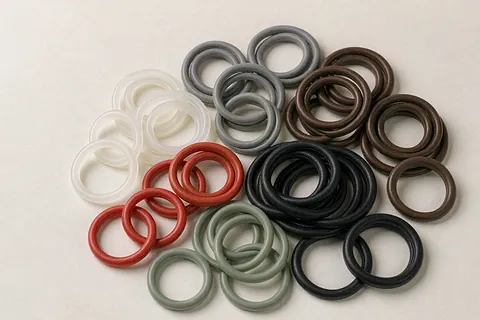
Not technically. Colour is a marker for identification and for some food-contact grades (white or blue for visual detection), not an indicator of formulation. Two rings of the same colour from different suppliers may be different compounds.