A pallet of O-rings that has sat in a warm warehouse for four years is not the same product as the one that was delivered. Rubber ages by the same mechanisms in storage as in service — oxidation, ozone attack, plasticiser migration — just more slowly, because there is no pressure and usually no fluid. ISO 2230 exists to slow that down, and to give a defensible answer to the question "is this batch still good?".
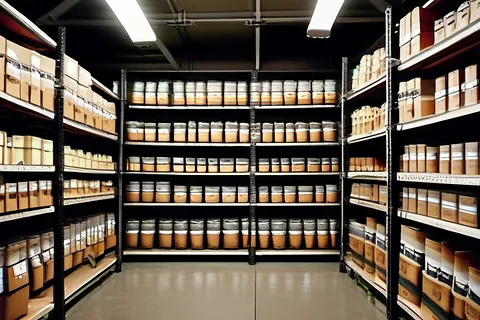
What ISO 2230 covers
The standard gives storage conditions and inspection procedures for rubber products, and it classifies materials into groups with different shelf lives. It distinguishes:
- Storage life — the period during which the product is expected to remain within specification under the specified storage conditions.
- Extension period — additional time after the storage life, granted only after inspection and testing.
- Service life — a different number, not covered by the storage standard.
The distinction matters commercially. A supplier who says "our shelf life is five years" may mean the standard's storage life, or the extension period, or the service life. Ask which, and ask what the storage conditions were.
The storage conditions that actually matter
ISO 2230 sets out conditions that are, in practice, a list of what goes wrong:
| Factor | Requirement | What happens if ignored |
|---|---|---|
| Temperature | 5–25 °C, ideally 15 °C | Every 10 °C above 25 °C roughly doubles the ageing rate |
| Humidity | Below 65 % RH, not condensing | Moisture promotes hydrolysis in some compounds; condensation supports mould |
| Light | Dark, no direct sunlight | UV and visible light oxidise the surface; a window is enough |
| Ozone | Away from electric motors, welding, mercury lamps, HV equipment | Ozone cracking is fast and irreversible, especially under tension |
| Deformation | Unstressed, in original packaging, no hanging, no stacking weight | A ring stored stretched or compressed takes a permanent set |
| Contact | No contact with solvents, oils, acids, or with other rubber types | Plasticiser migration between compounds changes hardness |
The ozone item deserves emphasis. Ozone attack is the fastest of the ageing mechanisms — it can crack a stretched ring in weeks — and the sources are everywhere in a plant: electric motors, fluorescent ballasts, welding equipment, copying machines. A ring hung on a nail next to a motor is being tested, not stored.
Shelf life by compound
The standard groups materials and gives storage life in years. The common groupings, in practical terms:
| Compound family | Typical storage life |
|---|---|
| NBR, HNBR | 15 years in the standard's grouping, with inspection |
| EPDM, IIR | 15 years |
| FKM, FFKM | 15 years |
| VMQ, FVMQ | 15 years |
| AU/EU (polyurethane) | 5 years |
These numbers assume the storage conditions are met and the parts are in unopened original packaging. A ring in a bin on a sunny windowsill has none of that protection, and no standard grants it a shelf life.
Polyurethane is the outlier and the one most often mishandled. PU hydrolyses in humid conditions, so a 5-year storage life can become two years in a damp store. If you use PU seals, buy in smaller quantities and control the humidity.
How to tell an aged ring from a good one
Three quick checks, in order:
- Hardness. Compare with the nominal, not with the datasheet of a fresh part. A change of more than about 15 points is a rejection, and a ring that has hardened by 10 points has already lost much of its low-temperature flexibility.
- Flex. Bend the ring double at several points. Surface cracks that open on bending mean the surface has oxidised. A ring that cracks at a bend is rejected regardless of its other properties.
- Appearance. Gloss loss, a bloom of white powder, tackiness, or a colour shift all indicate surface change. Bloom can be harmless (anti-tack agent) or a sign of plasticiser migration; if it wipes off and the surface underneath is sound, the ring is probably usable.
Dimension is the weakest check: an aged ring often measures nominal and still fails, because the change is chemical rather than dimensional.
Re-qualifying a batch past its date
A batch past its storage life is not automatically scrap. The standard's extension procedure is:
- Inspect a sample — appearance, hardness, flex.
- Test a sample against the original specification: hardness, tensile, elongation, compression set.
- If the sample passes, extend for a defined period and record it.
- Re-test at the end of the extension, or scrap.
The cost of that testing usually exceeds the value of the batch for standard parts. Which is why the practical answer for commodity O-rings is: use them within the storage life, and buy in quantities you will actually consume.
is not a climate-controlled room. It is keeping the original sealed bags closed until use, away from windows and motors, and not hanging rings on hooks. Most premature ageing in a store is caused by packaging discipline, not by the absence of air conditioning.
Storage mistakes that show up as field failures
- Rings stored on a hook. The ring is stretched for months, and the stretch becomes permanent. It installs with an oval section and leaks at two points.
- Bags left open in a workshop. Ozone from nearby equipment, plus solvent vapour from the bench, attacks the surface.
- Mixed compounds in one bin. Plasticiser migrates between compounds; a nitrile ring stored against a low-temperature compound can soften.
- Rings stored under a stack of boxes. Permanent deformation at the contact points, invisible until the ring is installed.
- Stock rotation ignored. The new delivery goes on top, the old batch stays at the bottom of the bin for years.
Frequently asked questions
How long can O-rings be stored?
ISO 2230 groups the common compounds at around 15 years of storage life under the specified conditions, and polyurethane at about 5 years. Those numbers assume 5–25 °C, below 65 % humidity, dark, unstressed, in original packaging.
Does the shelf life start at manufacture or at delivery?
At manufacture. A batch that spent a year in a distributor's warehouse has already used a year of its storage life, whether or not the packaging was opened.
Can I use an O-ring that has been in storage for ten years?
Inspect and test it: hardness, flex, appearance, and compression set against the specification. A ring that passes is usable; one that has hardened or cracks at a bend is scrap regardless of the date on the bag.
Does refrigeration extend shelf life?
Colder is better up to a point, but below about 5 °C condensation becomes a problem when the bag is brought into a warm room, and some compounds crystallise. 15 °C is the standard's recommendation, not 4 °C.
Are silicone O-rings immune to ageing?
No. Silicone resists heat and UV better than most compounds, but it still takes a set under load and can be attacked by solvents. The storage rules apply to it as well.